
Google Ads vs Meta Ads for Lead Generation: Which Should You Test First?
When your advertising budget is limited, “let’s try both” can be an expensive way to avoid making a decision.
Running Google Ads and Meta Ads together means preparing different campaigns, creating different ads and making sense of two sets of results. If neither receives enough budget or attention, you could finish the test without a clear reason to continue either one.
Before choosing a platform, ask a simpler question: How does someone become ready to buy what you sell?
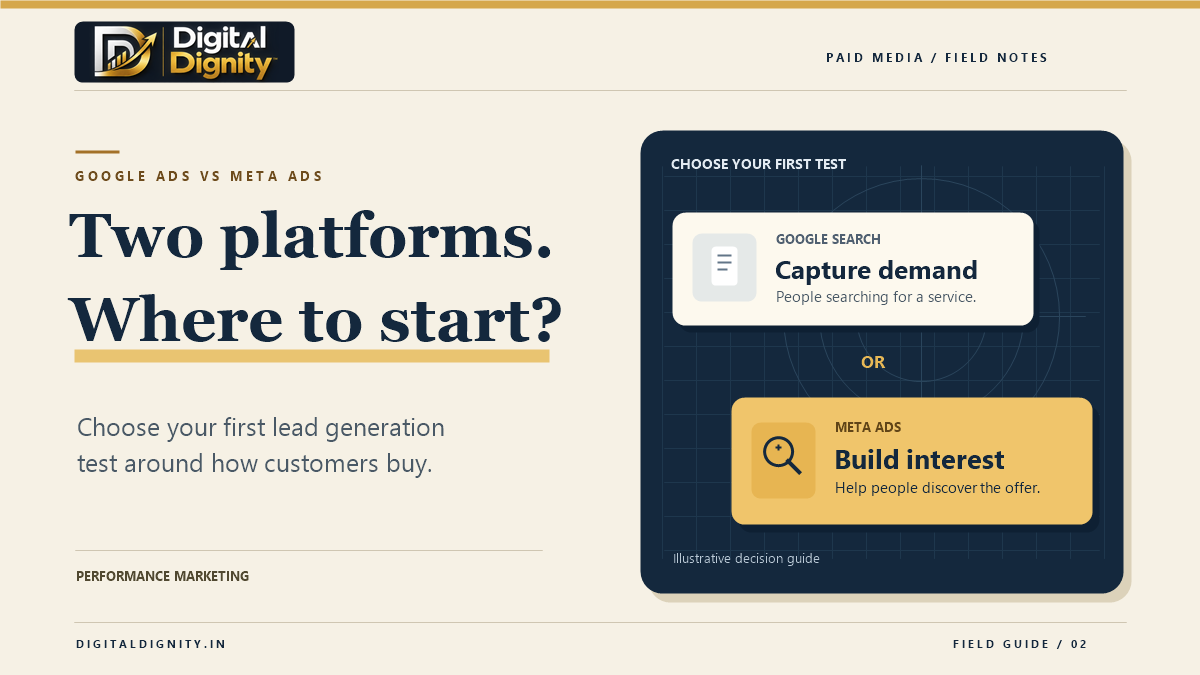
If people already recognise the need and search for a provider, Google Search is a sensible first test. If they need to discover the offer or see its value before enquiring, Meta may deserve the first test.
Neither choice guarantees good leads. The offer, the advertisement and what happens after the enquiry all matter.
Look at how your customer finds help
Imagine someone searching for an AC repair service. They have a problem and want someone to solve it. A relevant Google Search ad can reach them while they look for a provider. That is the central opportunity Google describes for Search campaigns: reaching people actively searching for products or services. Google Search campaign guidance
Now imagine a homeowner watching a kitchen renovation video on Instagram. They may not have been looking for a contractor that morning. Seeing a useful design, understanding the improvements and learning what the service includes could give them a reason to enquire.
These are illustrative examples, but the distinction is useful. One person is already looking for help. The other needs a reason to consider the offer.
For this comparison, “Google Ads” mainly means Google Search campaigns. Google offers other campaign types, and their role can differ from the search-led approach discussed here.
When Google Search is the stronger starting point
Start by checking whether people search for the service you want to sell in the area you can serve.
Then look beyond the number of searches. What does the person appear to need?
Someone searching “how kitchen renovation works” is asking a different question from someone searching “kitchen renovation contractor near me.” Both could eventually become customers, but they should not automatically be treated as equally ready for a sales conversation.
Google Search is a reasonable first choice when you have:
- A clearly defined service.
- Relevant searches from the market you serve.
- A page that answers the need expressed in those searches.
- A straightforward way to enquire.
The landing page needs to carry its share of the work. If the advertisement offers a specific service but sends visitors to a general homepage, they have to find the relevant information themselves.
Make the service, location, next step and any important conditions easy to understand. A visitor should be able to tell whether you can help before submitting a form.
And remember that a relevant search does not guarantee a suitable customer. If an existing campaign attracts enquiries your business cannot use, investigate the cause before increasing spend. Our guide to low-quality Google Ads leads looks more closely at that problem.
When Meta deserves the first test
Meta is worth considering first when showing the offer helps someone understand why they might want it.
A demonstration can make an unfamiliar service easier to understand. A useful visual comparison can explain a difference that would be difficult to communicate in a short text ad.
That does not mean every visually appealing business should start with Meta. The advertisement still needs to give the right person a clear reason to enquire.
A renovation video, for example, could attract people who like the design but live outside your service area or want work you do not provide. Showing what you offer, where you operate and what the next step involves helps people make a more informed decision.
Meta’s instant forms make it convenient for people to express interest. Convenience helps with capturing enquiries, but submitting a form does not establish that someone is suitable or ready to buy. Meta’s lead generation guide
Decide what your team needs to know before the first conversation. Depending on the service, that might include location, the type of requirement or expected timing.
Each question should have a purpose. If the answer will not change how you assess or handle the enquiry, consider whether you need to ask it.
Compare useful enquiries, not just cheap ones
Cost per lead is easy to compare. On its own, it leaves an important question unanswered: What happened to those leads?
Agree on what counts as a qualified enquiry before judging either platform. For a local service business, that could mean a reachable person within the service area who needs work the business actually provides.
Then follow the enquiry through the sales process:
- Could the team reach the person?
- Did the requirement fit the service?
- Did they book and attend the next step?
- Did the opportunity turn into business?
Cost per qualified enquiry gives a more useful comparison than form submissions alone. Once enough sales have closed, customer acquisition cost adds another part of the picture.
Record why enquiries are lost, too. Wrong locations, unsuitable requirements, unanswered calls and rejected quotations are different problems. Treating all of them as “bad leads” makes it harder to decide what needs fixing.
The same applies to follow-up. If enquiries wait unanswered or sales outcomes are never recorded, you have less evidence for deciding whether the advertising deserves more budget.
Where Digital Dignity fits in
Digital Dignity is a digital marketing agency based in Hyderabad, working with businesses across India and internationally. If you are considering support with lead generation, the useful starting point is a clear brief: what you sell, who you can serve and what makes an enquiry valuable to your business.
Those details make a conversation about advertising more productive. They give the platform choice a business context and create a clearer basis for judging the results.
Give the first test a clear job
Choose one service, one audience and one main outcome. Keep a record of the offer, campaign changes and feedback from the people handling enquiries.
Set a spending limit you can afford, and allow for the time customers normally take to decide. There is no single budget or fixed number of days that makes every lead generation test conclusive.
Before launching, decide what would justify continuing. That could be evidence of suitable enquiries at an acceptable cost, with enough follow-through to understand whether they become real opportunities.
If the budget cannot support two meaningful tests, start with the platform that best matches how your customers buy. Introduce the second when you have a specific question for it to answer.
Start with Google Search when people are already looking for the service you sell. Consider Meta first when discovery and explanation are central to generating interest.
From there, let qualified enquiries and actual sales guide the next decision. More form submissions are only useful when they help the business move forward.
FAQ
It depends on how your customers find and evaluate your service. Google Search is a sensible starting point when people actively search for what you offer. Meta may suit an offer that benefits from visual explanation or discovery. Compare qualified enquiries and sales before deciding which deserves more budget.
Neither platform is consistently cheaper for every business. Costs vary with the audience, competition, offer and campaign setup. A lower cost per form submission can still mean a higher cost per customer if fewer enquiries turn into business.
For the Google Search approach discussed here, a relevant landing page gives visitors somewhere to assess your service and enquire. Meta offers instant forms that collect enquiries within its apps. Whichever route you choose, people need enough information to understand the offer and what happens after they submit their details.
Use Digital Dignity’s Ad Channel Planner as a starting point for planning your advertising test. Alongside the planner, consider how customers find your service, what makes an enquiry valuable and how much you can comfortably spend testing.